

Power Engineer with 15+ years of experience in pulp and paper, power generation, and oil & gas processing facilities. Operating Manager at Power Engineering 101, helping students prepare for Canadian power engineering certification exams.
If you are exploring a career in power engineering, one of the first things you will encounter is the certification system. Power engineering has five levels in Canada, numbered from 5th or 4th class (the entry point) up to 1st class (the highest). The terms levels and classes mean the same thing and are used interchangeably across provinces, regulatory bodies, and study materials. Whether someone says “power engineering levels” or “power engineering classes,” they are referring to the same certification structure.
This article covers every power engineering level from entry to the top, what each one involves, how many exams are required, and what jobs and salaries are available at each stage.
Power engineering levels in Canada
Power engineering certification in Canada is governed nationally by the Standardisation of Power Engineer Examinations Committee (SOPEEC). SOPEEC was established to create a uniform national examination system and improve the mobility of certified power engineers between provinces.
All certification levels follow the SOPEEC syllabus, which means the content you study is consistent regardless of whether you are writing your exam in Alberta through ABSA, in Ontario through the TSSA, in British Columbia through TSBC, or through any other provincial authority.
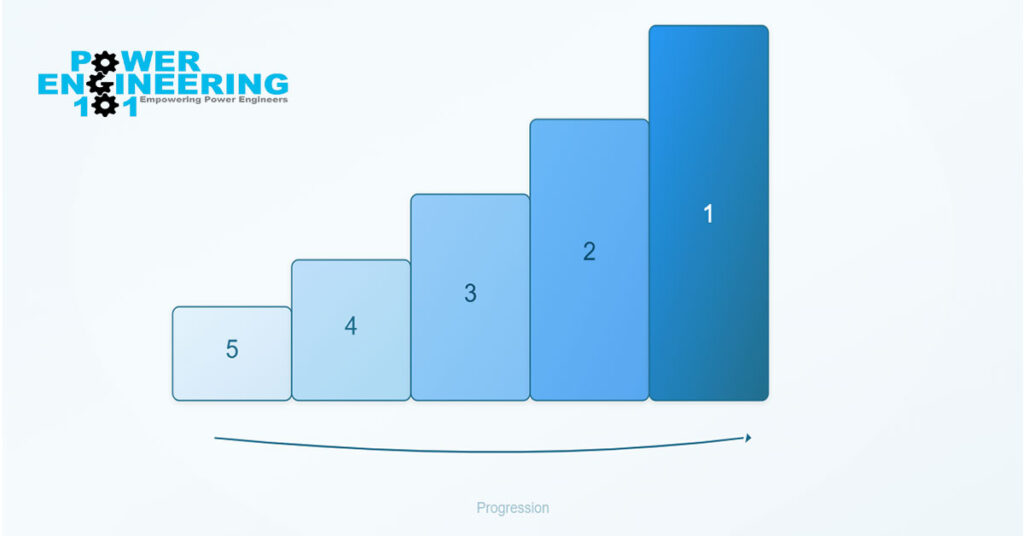
There are five power engineering levels in Canada. Certification progresses from 5th class (entry level) through 4th, 3rd, 2nd, and up to 1st class. Each level requires passing the applicable SOPEEC examinations and accumulating the required work experience, known as firing time. The pass mark for all SOPEEC exams is 65%, regardless of the level or province.
The table below summarizes the structure of power engineering levels in Canada, including the number of exam papers at each level:
| Level | Also called | Number of exam papers | Prerequisite |
| Level 5 (5th class) | 5th class | 1 paper | Completed approved course or boiler hours |
| Level 4 (4th class) | 4th class | 2 papers (4A and 4B) | Completed approved course |
| Level 3 (3rd class) | 3rd class | 4 papers (3A1, 3A2, 3B1, 3B2) | 4th class certificate |
| Level 2 (2nd class) | 2nd class | 6 papers (2A1, 2A2, 2A3, 2B1, 2B2, 2B3) | 3rd class certificate |
| Level 1 (1st class) | 1st class | 8 papers (1A1-1A4, 1B1-1B4) | 2nd class certificate |
Power engineering level 5
The 5th class power engineering level may be the starting point for candidates entering the profession, geared toward building operation and maintenance. It focuses on the fundamentals of boiler operation, plant safety, fuels and combustion, basic controls, and general science. There is one exam paper, consisting of 100 multiple-choice questions with a 3-hour time limit.
To qualify for the 5th class exam in Alberta, a candidate must have either completed an approved course and operated a heating plant boiler for 6 months, or hold a degree in mechanical engineering from an approved university. Requirements vary slightly by province, so candidates should confirm eligibility with their provincial regulator before registering.
The 5th class level authorises its holder to operate and maintain boilers in commercial heating and manufacturing environments. Typical settings include commercial buildings, institutional facilities, and smaller industrial plants. Power engineers at this level work under the supervision of higher-certified engineers in larger plants.
To prepare for the 5th class exam, the recommended starting point is the 5th class power engineering tutorial course at Power Engineering 101. The course is structured according to the SOPEEC syllabus and includes study guides, practice questions, and tutoring support.
Power engineering level 4
The 4th class power engineering level is considered the higher-level entry point into the profession. Candidates who enter at the 4th class level skip 5th class entirely and proceed directly from here. This level covers both boiler plant and refrigeration plant operation, making 4th class engineers more versatile than those holding only a 5th class certificate.
There are two exam papers at this level: 4A and 4B. The 4A paper focuses on the theoretical and scientific foundations of power engineering, including boilers and boiler systems, chemistry and thermodynamics, safety, and instrumentation and controls. The 4B paper shifts to the operational side, covering boiler plant operations, refrigeration, pumps and compressors, and water treatment. Both papers consist of 100 multiple-choice questions with a 3-hour time limit each. The pass mark is 65% on each paper.
To write the 4th class exam in Alberta, candidates must have completed a 4th class course satisfactory to the Administrator (such as the ABSA-accepted courses offered by Power Engineering 101), completed the first full term of a 2-year power engineering technology program, or hold a mechanical engineering degree. Work experience requirements for certification include a minimum of 6 months assisting in the operation of a qualifying power plant. Check with your provincial authority for your province’s specific requirements.
For Alberta students, Power Engineering 101 offers ABSA-accepted 4th class courses for both 4A and 4B. Completion of these courses satisfies the course prerequisite for writing the provincial exam. For students outside Alberta or those seeking additional exam preparation, non-ABSA 4th class tutorial courses are also available.
Power engineering level 3
The 3rd class power engineering level represents a significant step up in responsibility and technical depth. At this level, power engineers are qualified to supervise, operate, and maintain 3rd class plants, which span a wide range of industries including oil and gas, pulp and paper mills, hospitals, universities, food manufacturing, and other industrial facilities.
There are four exam papers at the 3rd class level: 3A1, 3A2, 3B1, and 3B2. The A papers cover the engineering science and theory side, while the B papers focus on applied plant systems and equipment. Each paper consists of 100 multiple-choice questions with a 3-hour time limit. To write the 3rd class exam, a candidate must already hold a 4th class power engineer’s certificate.
Work experience requirements for 3rd class certification typically require a minimum of 12 months as a power engineer in a qualifying plant or a longer period in a lower supervisory capacity, depending on the type of plant and the power engineers role. Candidates who complete an approved 3rd class course may be eligible for a reduction in the required firing time. Confirm the specific requirements with your provincial authority.
Power Engineering 101 offers tutorial courses for all four 3rd class exam papers. You can find and enroll in the power engineering courses.
Power engineering level 2
The 2nd class power engineering level involves supervisory responsibility over other engineers and contractors. Power engineers certified at this level are qualified to act as shift engineers and assistant shift engineers in 2nd class plants and to relieve 1st class engineers when required.
There are six exam papers at the 2nd class level: 2A1, 2A2, 2A3, 2B1, 2B2, and 2B3. The transition to multiple-choice format happened in two stages, as confirmed by ABSA. Papers 2A2, 2A3, 2B1, 2B2, and 2B3 transitioned to a 100-question multiple-choice format effective January 1, 2024. Paper 2A1 followed, transitioning to multiple-choice effective January 1, 2025. All six papers are now in multiple-choice format, each with a 3-hour time limit. To qualify to write the 2nd class exams, a candidate must already hold a 3rd class power engineer’s certificate.
Work experience for 2nd class certification typically requires 24 months in a qualifying supervisory role in a power plant that requires 3rd class-certified personnel in its shift engineer, assistant shift engineer, or chief power engineer positions. Candidates may be eligible for a reduction in firing time upon completion of an approved 2nd class course. Confirm current requirements with your provincial authority.
Power Engineering 101 provides 2nd-class tutorial courses for all six exam papers. Tutoring support is included with every course, and bundled discounts are available when purchasing multiple papers together.
Power engineering level 1
The 1st class power engineering level is the highest certification available in Canada. A 1st class power engineer is qualified to supervise any type or capacity of power plant, heating plant, or thermal liquid heating system. This is the level required to serve as a chief power engineer in the largest and most complex plant environments in the country.
There are eight exam papers at the 1st class level: 1A1, 1A2, 1A3, 1A4, 1B1, 1B2, 1B3, and 1B4. As of January 2026, paper 1B4 has been converted to a 100-question multiple-choice format. The remaining seven papers (1A1 through 1A4 and 1B1 through 1B3) are still written in long-answer essay format, with each paper consisting of seven questions of which five must be attempted, and a 3.5-hour time limit per paper. To qualify to write the 1st class exams, a candidate must hold a 2nd class power engineer’s certificate.
Work experience for 1st class certification in Alberta requires one of the following, as set out by ABSA: 30 months as a chief power engineer or shift engineer in a qualifying plant; 45 months as an assistant shift engineer in a plant exceeding 10,000 kW; or a combination of 15 months in a qualifying role plus 15 months in a pressure plant or 36 months in a supervisory capacity in pressure equipment work. Additional credits may apply for mechanical engineering degree holders, 1st class marine engineers or those who complete an approved 1st class course. Requirements vary by province, so confirm current requirements with your provincial authority. Check the ABSA first class certification page or your provincial authority for the current requirements.
Power Engineering 101 offers 1st class tutorial courses for all eight papers. Bundled discounts are available for candidates purchasing all A or all B papers, or all eight papers together.
What is the top level of power engineering?
The top level of power engineering in Canada is the 1st class power engineer’s certificate of competency. There is no certification level above 1st class. As confirmed by ABSA and the SOPEEC certification structure, power engineer certification progresses from entry level at 5th or 4th class through 3rd, 2nd, and up to 1st class, which is the ceiling of the system.
A 1st class power engineer is authorized to supervise any type or capacity of power plant in Canada. This includes large-scale thermal power generation stations, refineries, petrochemical facilities, and any other plant environment, regardless of its size or complexity. The 1st class certificate is required by regulation to hold the chief power engineer position in the largest and highest-capacity plants.
Reaching 1st class requires passing all eight SOPEEC exam papers, accumulating the required firing time in qualifying plant roles, and holding a valid 2nd class certificate. Given the scope and volume of the exams involved, most candidates benefit from structured study support. The Power Engineering 101 1st class tutorial courses cover all eight papers and include a 30% bundle discount when all courses are purchased together.
What are the best training programs for advancing through power engineering levels?
When it comes to advancing through the power engineering levels, structured exam preparation is one of the most important factors in passing efficiently. Power engineering courses vary in format, depth, and cost, but the most effective programs share a few key qualities: they follow the SOPEEC syllabus, provide regular practice testing, and offer access to tutoring support from working power engineers.
Power Engineering 101 offers online tutorial courses for every level from 5th class through to 1st class. Each course is built to align with the SOPEEC syllabus and includes study guides organised by topic, multiple-choice quizzes after each chapter, a final exam simulation that mimics real exam conditions, and one-on-one tutoring support via email or video call. Courses are self-paced with a recommended minimum of 10 hours per week, and access is extended at no additional charge until the candidate passes their provincial exam.
For 4th class candidates in Alberta, Power Engineering 101 also offers ABSA-accepted 4th class courses for both 4A and 4B. Completing these courses satisfies the course prerequisite required by ABSA to register for the provincial exam in Alberta. Course prerequisites vary by province, so candidates outside Alberta should confirm the requirements with their provincial authority before registering.
All courses are backed by a pass guarantee: if a candidate completes the course and does not pass their provincial exam on the next attempt, Power Engineering 101 will continue tutoring at no additional charge or provide a full refund.
Provincial colleges and polytechnic institutions also offer power engineering programs that provide qualifying experience time reductions upon completion. However, these programs typically cover only up to the 2nd class and require in-person attendance. Online preparation through Power Engineering 101 is compatible with full-time employment and is available to candidates in all provinces.
Where can I find practice tests for power engineering certification levels?
Practice tests are an essential part of preparing for any SOPEEC exam. They help candidates identify knowledge gaps, build confidence under timed conditions, and get familiar with the question format before the actual exam.
Power Engineering 101 offers practice exams for every power engineering level, from 5th class through to all eight 1st class papers. Each practice exam is multiple-choice and provides immediate feedback on correct and incorrect answers, along with a graded results summary emailed after completion. Candidates receive one month of unlimited access per exam.
Individual practice exams are available for: the 5th class, 4A, 4B, 3A1, 3A2, 3B1, 3B2, 2A1, 2A2, 2A3, 2B1, 2B2, 2B3, and 1B4 papers. For candidates preparing for the written essay-format 1st class papers, the 1st class tutorial courses include practice material structured according to the SOPEEC syllabus.
Practice exams can be purchased individually or as part of a tutorial course bundle. For candidates who want to assess their readiness before committing to a full course, starting with a practice exam is a useful first step. The free resources section of the Power Engineering 101 website also includes sample questions and supplementary material at no cost.
What is the highest-paid type of power engineer?
The highest-paid power engineers in Canada are those who hold a 1st or 2nd class certificate and work in large industrial plants such as power generation stations, oil refineries, and petrochemical facilities. The higher the class of certification, the greater the scope of responsibility and, generally, the higher the compensation.
According to the Government of Canada Job Bank (NOC 92100, updated November 2025), the national wage range for a first-class power engineer runs from $30.00 per hour at the low end to $75.55 per hour at the high end, with a national median of $49.23 per hour. The highest median wages in Canada for this occupation are found in Alberta and Ontario.
| Province/territory | Low ($/hr) | Median ($/hr) | High ($/hr) |
| Alberta | $31.00 | $57.69 | $73.00 |
| Ontario | $33.37 | $57.00 | $87.00 |
| Newfoundland and Labrador | $25.00 | $45.90 | $67.31 |
| Yukon Territory | $30.04 | $49.36 | $74.74 |
| Canada (national) | $30.00 | $49.23 | $75.55 |
| British Columbia | $35.00 | $41.00 | $66.87 |
| New Brunswick | $25.85 | $43.27 | $58.15 |
| Saskatchewan | $25.87 | $40.00 | $69.71 |
| Manitoba | $29.00 | $39.50 | $50.48 |
| Quebec | $24.60 | $37.50 | $57.00 |
| Nova Scotia | $25.37 | $35.00 | $50.00 |
| Prince Edward Island | $24.92 | $28.50 | $49.04 |
| Northwest Territories | $31.64 | $44.14 | $62.91 |
| Nunavut | $35.43 | $46.49 | $62.88 |
These wages apply across the NOC 92100 group, which includes power engineers and power systems operators. Wages vary based on the level of certification held, the type and size of plant, shift premiums, and years of experience. Power engineers holding 1st class certificates in Alberta’s oil sands and energy sector, and in Ontario’s industrial and power generation sector, tend to command the highest compensation.
For candidates currently working toward higher certification levels, advancing from 4th class to 3rd class, or from 3rd class to 2nd class, typically results in a measurable wage increase, as many employers tie pay grades directly to certificate class. Reaching 1st class opens access to chief power engineer and plant manager roles, which are among the highest-compensated positions in the trades.
Jobs for different power engineering levels
Power engineers are employed across a wide range of industries in Canada, and the types of roles available to you depend directly on your certification level. According to sources, power engineers and power systems operators are employed in power generation plants, electrical power utilities, manufacturing plants, hospitals, universities, and government and commercial establishments.
Below is an overview of the types of jobs typically available at each power engineering level:
- 5th class: Boiler operator, heating plant operator, refrigeration plant operator. Typically found in commercial buildings, institutional facilities, ice rinks, and smaller heating plants. Often supervised by a higher-certified engineer.
- 4th class: Boiler plant operator, assistant engineer, fired process heater, operator. Qualified to supervise smaller power plants and take on chief engineer roles in plants with capacity requirements below 3rd class. Found in manufacturing, hospitality, commercial real estate, and light industrial settings.
- 3rd class: Shift engineer, assistant shift engineer, chief power engineer (in 3rd class plants). Works in oil and gas, pulp and paper mills, food processing plants, hospitals, and other mid-scale industrial environments. Takes on more complex troubleshooting and maintenance oversight.
- 2nd class: Shift engineer, assistant shift engineer, supervisor of 3rd class plants, relief engineer for 1st class positions. Found in large industrial plants, power utilities, refineries, and heavy manufacturing. Responsible for coordinating engineers and contractors during shifts.
- 1st class: Chief power engineer, plant manager, senior shift engineer in any class of plant. Qualified to supervise any type or capacity of power plant, heating plant, or thermal liquid heating system in Canada. Common in thermal power generation stations, oil sands operations, large refineries, and major industrial complexes.
Regardless of the level you currently hold, each certification step unlocks new job titles, higher plant classifications, and greater earning potential. If you are looking for power engineering roles in your area, the Power Engineering 101 job board lists current openings across Canada.

Hi! I’m not sure if you answer questions like this, so please disregard, if not. I work at a Church with a low pressure modular boiler. I have been employed there for almost 3 years (35 months), working with a guy who has his Fireman’s Boiler Certificate. I am in the midst of trying to get my Fireman’s Boiler Certificate, but somehow ended up writing the exam for a 5th Class Power Engineer (probably my mistake, clicked the wrong button). I passed that exam, but now need the experience portion to complete the requirements for being a 5th Class Power Engineer. With working under the other guy for almost three years, would he be able to sign off on my hours? If that worked and I held a Class 5 Power Engineer certificate, would that meet the Church’s requirement for needing someone with a Fireman’s Boiler certificate? Or, would I have to write and pass the Fireman’s Boiler exam? Thanks very much for your time! Darryl McRae (#306-270-5182)